Which Facial Rejuvenation Treatment Is Right for You?
An Evidence-Based Guide to Regenerative Aesthetics, Neuromodulators, Fillers, and Laser Facial Rejuvenation
Advances in non-surgical facial rejuvenation continues to grow, patients are increasingly seeking treatments that improve appearance while still looking natural and preserving facial expression.
Terms like Botox Cosmetic, PRP, PRF, dermal fillers, and laser rejuvenation are often discussed online, but these treatments work in very different ways biologically and cosmetically.
Some treatments temporarily relax muscles. Others restore lost volume. Others stimulate collagen remodeling and tissue regeneration over time.
Understanding these differences is important when deciding which treatment — or combination of treatments — may best fit your goals, anatomy, lifestyle, and comfort level.
Patients throughout River Forest, Oak Park, and the greater Chicagoland area are increasingly interested in regenerative facial rejuvenation treatments that emphasize natural-looking results, collagen support, and minimally invasive approaches to aging.
At Global Facial Aesthetics & Rejuvenation, our philosophy focuses heavily on regenerative and collagen-stimulating therapies designed to improve tissue quality while preserving natural facial movement and expression.
Quick Definitions
Botox
A neuromodulator that temporarily relaxes targeted facial muscles to reduce dynamic wrinkles caused by repetitive facial movement. The effect dissipates by a process of sprouting of several new nerve endings that eventually regress as the parent nerve recovers function.
PRP (Platelet-Rich Plasma)
A regenerative treatment created from a patient’s blood that concentrates platelets and growth factors to support healing, collagen stimulation, and tissue rejuvenation.¹
PRF (Platelet-Rich Fibrin)
A fibrin-rich regenerative blood product derived from a patient’s blood that allows slower release of growth factors and contains more stem cells as compared with PRP.²
Dermal Fillers
Injectable gel-like substances harvested from animals or bacteria, commonly hyaluronic acid-based, used to restore facial volume and contour.
Fotona Laser Treatments
Laser-based procedures designed to stimulate collagen remodeling, skin tightening, and tissue rejuvenation using controlled laser energy.³
Understanding the Main Categories of Facial Rejuvenation Treatments
Facial aging occurs for several reasons simultaneously, including:
- collagen loss,
- decreased skin elasticity,
- repetitive muscle movement,
- volume loss,
- thinning skin,
- changes in facial bone structure,
- and cumulative sun damage.
- Senescence at the cellular level
Different aesthetic treatments address different parts of this aging process.
Some treatments focus on relaxing muscles, while others focus on restoring volume, stimulating collagen production, improving skin texture, or supporting tissue regeneration.
What Is Botox?
Botox Cosmetic is a neuromodulator derived from botulinum toxin type A.⁴
It works by temporarily reducing communication between nerves and specific facial muscles. This decreases repetitive muscle contraction that contributes to “dynamic wrinkles” — wrinkles caused by facial movement and expression.
Botox is commonly used for:
- forehead lines,
- frown lines (“11s”),
- crow’s feet,
- jaw clenching,
- facial slimming,
- and neck banding.
Botox Works Best For:
- dynamic wrinkles,
- excessive muscle movement,
- TMJ-related clenching,
- masseter hypertrophy,
- and wrinkle prevention in select patients.
Advantages of Botox
- Fast treatment
- Minimal downtime
- Predictable wrinkle softening
- FDA-approved for multiple medical and cosmetic uses
- Often noticeable within several days
Potential Downsides
- Temporary results
- Requires repeat treatments
- Does not directly improve skin quality
- Does not restore lost volume
- Over-treatment may create an unnatural or “frozen” appearance
- Possible asymmetry or eyelid drooping in rare cases⁴
Most Botox results last approximately 3–6 months.
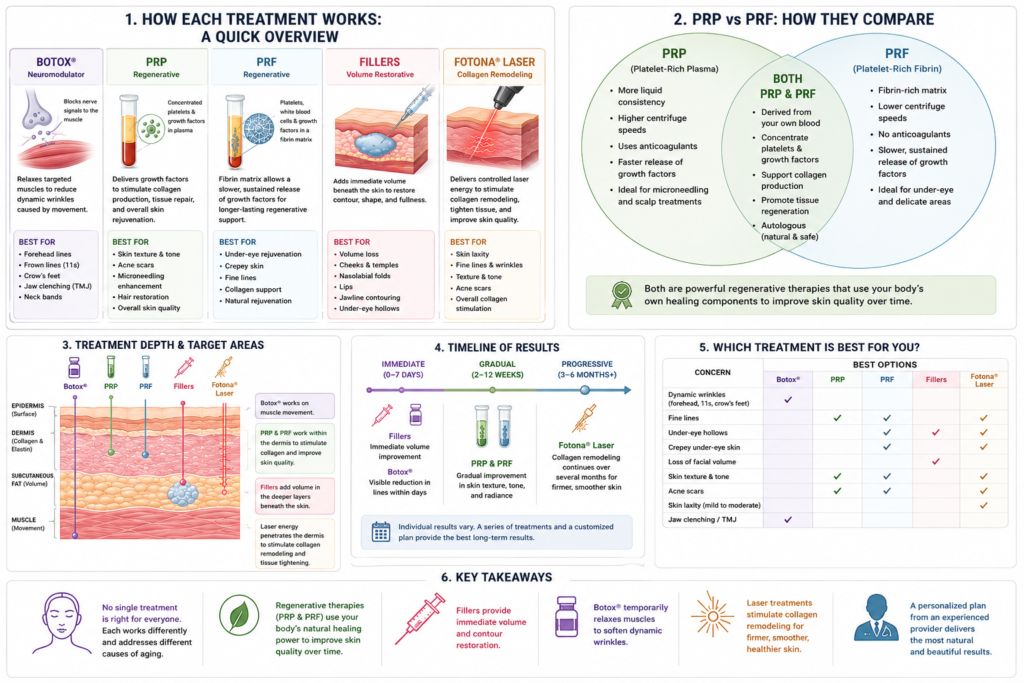
VISUAL GRAPHIC RECOMMENDATION
“How Facial Rejuvenation Treatments Work”
A five-column infographic visually comparing:
- Botox → muscle relaxation
- PRP → growth factor signaling
- PRF → fibrin-supported regenerative signaling
- Fillers → physical volume replacement
- Fotona laser → collagen remodeling
Suggested visual elements:
- muscle fibers,
- collagen strands,
- laser penetration,
- platelet illustrations,
- syringe icons,
- and skin-layer anatomy.
What Are PRP and PRF?
Platelet-Rich Plasma (PRP) and Platelet-Rich Fibrin (PRF) are both regenerative treatments created from your own blood.¹ ²
These treatments are often grouped together because they share an important foundational concept:
PRP and PRFconcentrate the body’s natural healing and signaling cells, hormones, proteins and enzymes and reintroduce them into targeted tissues to stimulate regeneration and collagen remodeling and volume.
Both PRP and PRF contain concentrated platelets, which release growth factors and signaling molecules associated with:
- collagen production,
- tissue repair,
- blood vessel formation,
- wound healing,
- and regenerative cellular activity.¹ ²
Because they are derived from the patient’s own blood, both treatments are considered autologous therapies, meaning the material comes directly from the patient rather than from a synthetic or foreign substance.
PRP and PRF are commonly used in:
- facial rejuvenation,
- under-eye rejuvenation,
- hair restoration,
- microneedling enhancement,
- scar treatment,
- skin texture improvement,
- Restoring volume to wrinkles and lines
- and regenerative medicine applications associated with wound healing.
What Do PRP and PRF Have in Common?
Both PRP and PRF:
- are derived from a blood draw,
- utilize centrifugation to separate blood components,
- concentrate platelets and growth factors,
- support collagen stimulation,
- promote tissue regeneration,
- and aim to improve tissue quality rather than simply masking aging changes.
Unlike traditional fillers, PRP and PRF are not primarily designed to create dramatic immediate volume. Instead, they focus on improving tissue health and regenerative signaling over time.
Patients often choose PRP or PRF because they are interested in:
- natural-looking rejuvenation,
- regenerative aesthetics
- collagen support,
- minimally invasive facial rejuvenation,
- and treatments that use the body’s own biological materials.
How Are PRP and PRF Different?
Although PRP and PRF are closely related, they differ in how they are processed and how they behave biologically.
PRP (Platelet-Rich Plasma)
PRP is created by centrifuging blood to isolate a concentrated platelet-rich plasma layer.¹
This process often involves:
- higher centrifuge speeds,
- shorter spin protocols,
- and anticoagulants to prevent clotting.
The resulting plasma contains concentrated platelets and growth factors in a more liquid form.
PRP tends to release growth factors relatively quickly after treatment.
PRP Is Often Used For:
- microneedling enhancement,
- generalized skin rejuvenation,
- scalp and hair restoration,
- acne scars,
- and skin texture improvement.
PRF (Platelet-Rich Fibrin)
PRF is considered by many clinicians to be a modified evolution of PRP preparation protocols.²
PRF processing typically uses:
- slower centrifugation speeds,
- lower relative centrifugal force,
- and no anticoagulants.
This creates a fibrin-rich matrix containing:
- platelets,
- white blood cells,
- fibrin scaffolding,
- and regenerative signaling components.
- concentration of the blood’s natural hormones, enzymes and proteins
Because of this fibrin structure, PRF may allow for slower and more sustained release of growth factors over time and provide greater immediate volumization.²
PRF also has a thicker consistency than PRP, which may make it particularly useful in certain facial rejuvenation applications.
PRF Is Commonly Used For:
- under-eye rejuvenation,
- crepey skin,
- fine lines,
- collagen support,
- and regenerative facial treatments.
VISUAL GRAPHIC RECOMMENDATION
PRP vs PRF Venn Diagram
PRP Side
- More liquid
- Faster growth factor release
- Often used with microneedling
- Typically uses anticoagulants
Shared Center
- Derived from patient blood
- Platelet concentration
- Growth factors
- Regenerative medicine
- Collagen stimulation
- Natural facial rejuvenation
PRF Side
- Fibrin matrix
- Slower release
- No anticoagulants
- Scaffold structure
- Regenerative aesthetics focus
PRP vs PRF: Key Differences at a Glance
| Feature | PRP | PRF |
| Derived from patient blood | Yes | Yes |
| Platelets concentrated | Yes | Yes |
| Growth factors | Yes | Yes |
| Uses anticoagulants | Usually | No |
| Consistency | More liquid | More fibrin-rich |
| Growth factor release | Faster | More gradual |
| Regenerative focus | Yes | Yes |
| Common uses | Microneedling, | Under-eyes, regenerative aesthetics, hair restoration |
Why Many Patients Are Interested in Regenerative Treatments
Many patients today are increasingly interested in treatments designed to:
- stimulate collagen naturally,
- improve tissue quality,
- preserve facial expression,
- and avoid an overfilled or artificial appearance.(BOCCA FACE)
For this reason, regenerative approaches such as PRP, PRF, and laser collagen stimulation have become increasingly popular among patients seeking gradual, natural-looking rejuvenation.
These approaches generally focus less on masking aging and more on improving tissue health and collagen support over time.
At Global Facial Aesthetics & Rejuvenation, regenerative therapies are often combined with Fotona laser treatments to support collagen remodeling and comprehensive tissue rejuvenation. The addition of the laser stimulates your MITOCHONDRIA to produce more energy and enhance appearance.
What Are Dermal Fillers?
Dermal fillers are injectable substances designed to restore lost volume or reshape facial contours.⁵
Most modern fillers are made of hyaluronic acid derived from animal or bacterial sources, the human body also produces natural hyaluronic acid.
Fillers are commonly used fo r increasing volume of:
- cheeks,
- lips,
- nasolabial folds,
- jawline contouring,
- temples,
- and under-eye hollows.
Unlike PRF or PRP, fillers physically occupy space immediately after placement.
Advantages of Fillers
- Immediate visible volume
- Structural contour enhancement
- Long-lasting in some areas
- Can improve facial balance
Potential Downsides
- Risk of migration
- Swelling and bruising
- Vascular occlusion risk (rare but serious)
- Puffiness or overfilled appearance
- Some patients dislike an unnatural aesthetic outcome
- Does not directly improve skin quality⁵
- Requires more volume to fill the skin more and more (BOCCA FACE)
Depending on the product used, fillers may last from 6 months to over 18 months.
At this time, our office focuses primarily on regenerative therapies rather than traditional dermal fillers.
How Fotona Laser Treatments Differ
Fotona laser treatments approach facial rejuvenation differently from injectables.³
Rather than adding volume or reducing muscle movement, Fotona laser technologies are designed to stimulate tissue remodeling and collagen production using controlled laser energy.
Depending on the treatment protocol, Fotona lasers may help improve:
- skin tightening,
- collagen remodeling,
- fine lines,
- texture,
- laxity,
- vascularity,
- and mucosal tightening.
At Global Facial Aesthetics & Rejuvenation, we commonly utilized Fotona-based treatments include:
- SmoothLase®,
- NightLase®,
- NaseLase
- and laser-assisted rejuvenation protocols.
Advantages of Laser Rejuvenation
- Non-surgical
- Collagen stimulation
- Texture improvement
- Natural-looking results
- Enhances combination of PRP and PRF
- No foreign material added
Potential Downsides
- Gradual improvement
- Multiple sessions may be needed
- Temporary redness or swelling
- Results depend on collagen response and skin condition
VISUAL GRAPHIC RECOMMENDATION
Facial Anatomy Layer Diagram
Cross-sectional facial anatomy illustration showing:
- epidermis,
- dermis,
- collagen layers,
- fat pads,
- muscle layers.
Overlay treatment depth examples:
- Botox → muscle layer
- Fillers → fat compartments
- PRF/PRP → superficial/subdermal placement
- Laser → dermal collagen remodeling
Botox vs PRF vs Fillers: What’s the Difference?
| Treatment | Primary Mechanism | Best For | Results Timeline |
| Botox | Relaxes muscle movement | Dynamic wrinkles | Days |
| PRP | Growth factor stimulation | Skin quality & regeneration | Gradual |
| PRF | Sustained regenerative signaling, Volume | Natural rejuvenation | Gradual |
| Fillers | Adds physical volume | Volume loss & contouring | Immediate |
| Fotona Laser | Collagen remodeling | Tightening & texture | Progressive |
Which Treatment Is Best for Specific Concerns?
| Concern | PRF / PRP | Fotona Laser | Botox | Fillers |
| Crow’s feet | Possible adjunct | Yes | Yes | Rarely |
| Jaw clenching / TMJ tension | No | No | Yes | No |
| Under-eye hollowness | Yes | Adjunct | No | Yes |
| Crepey under-eye skin | Yes | Yes | No | No |
| Skin texture | Yes | Yes | No | No |
| Acne scars | Yes | Yes | No | No |
| Mild skin laxity | Adjunct | Yes | No | No |
| Natural rejuvenation goals | Yes | Yes | Possible adjunct | Less commonly |
| Collagen stimulation | Yes | Yes | No | No |
| Immediate facial contouring | Modest | No | No | Yes |
Who May Prefer Botox?
Patients primarily concerned with:
- forehead movement lines,
- crow’s feet,
- jaw clenching,
- or excessive muscle activity.
Who May Prefer PRP or PRF?
Patients interested in:
- regenerative facial rejuvenation,
- collagen stimulation,
- natural-looking results,
- improving tissue quality gradually,
- and minimally invasive aesthetic approaches.
Who May Prefer Laser Rejuvenation?
Patients concerned with:
- skin texture,
- mild skin laxity,
- collagen support,
- fine lines,
- and overall skin quality improvement.
Can Treatments Be Combined?
Yes. In many cases, combination therapy may provide the most comprehensive results.
Examples may include:
- PRF with laser rejuvenation,
- PRP with microneedling,
- Botox with regenerative treatments,
- or laser resurfacing combined with collagen stimulation therapies.
Because facial aging is multifactorial, treatment plans are individualized rather than one-size-fits-all.
Our Philosophy at Global Facial Aesthetics & Rejuvenation
At Global Facial Aesthetics & Rejuvenation, our approach emphasizes:
- natural facial movement,
- regenerative medicine principles,
- collagen stimulation,
- minimally invasive facial rejuvenation,
- and conservative, personalized treatment planning.
For this reason, our office primarily focuses on:
- PRF,
- PRP,
- and Fotona laser-based rejuvenation therapies,
while selectively utilizing Botox in appropriate situations.
Our goal is not simply to reduce wrinkles, but to support healthier, more natural-looking tissue quality over time.
Frequently Asked Questions
What is the difference between PRP and PRF?
Both are regenerative blood-derived treatments that utilize concentrated platelets and growth factors. PRF contains a fibrin matrix and typically does not use anticoagulants, which may allow for slower release of growth factors over time.²
Is PRF safer than filler?
Because PRF is derived from your own blood, there is minimal risk of allergic reaction. Traditional fillers carry additional risks, including vascular complications and migration.⁵
Does PRF work like Botox?
No. Botox relaxes muscle movement, while PRF focuses on regenerative signaling and collagen support.
Is PRF a filler?
PRF is not considered a traditional filler. It may provide subtle volumizing effects in some areas, but its primary purpose is regenerative stimulation.
Which treatment looks the most natural?
This depends on treatment goals and technique, but many patients seeking subtle, gradual rejuvenation prefer regenerative therapies such as PRF and laser collagen stimulation.
Can PRF replace fillers completely?
Not always. Significant structural volume loss may still require filler-based approaches in some patients.
How long does Botox last?
Botox results commonly last approximately 3–6 months, though duration varies by patient and treatment area.⁴
Can laser treatments stimulate collagen?
Yes. Many laser treatments are designed to stimulate collagen remodeling and improve tissue quality over time.³
The Bottom Line
There is no single “best” facial rejuvenation treatment for everyone.
Each option works differently:
- Botox reduces muscle activity,
- fillers restore volume,
- PRP and PRF support regenerative process,
- and Fotona laser treatments stimulate collagen remodeling and tissue rejuvenation.
The most appropriate treatment depends on:
- your anatomy,
- your goals,
- your comfort level,
- your timeline,
- and the type of aging changes being addressed.
A personalized consultation is often the best way to determine which approach aligns most closely with your desired outcome.
Interested in learning which regenerative or aesthetic treatment approach may best fit your goals?
Schedule a consultation with Global Facial Aesthetics & Rejuvenation in River Forest to discuss personalized facial rejuvenation options designed around your anatomy, goals, and long-term tissue health.
Reviewed By
Dr. [FULL NAME], DDS
Global Facial Aesthetics & Rejuvenation
River Forest, Illinois
Areas of focus include:
- regenerative facial aesthetics,
- PRF/PRP therapies,
- laser rejuvenation,
- facial harmony,
- and minimally invasive aesthetic treatments.
References (AMA 11th Edition)
- Marx RE. Platelet-rich plasma (PRP): what is PRP and what is not PRP? Implant Dent. 2001;10(4):225-228. doi:10.1097/00008505-200110000-00002
https://pubmed.ncbi.nlm.nih.gov/11813662/ - Miron RJ, Fujioka-Kobayashi M, Bishara M, et al. Platelet-rich fibrin and soft tissue wound healing: a systematic review. Tissue Eng Part B Rev. 2017;23(1):83-99. doi:10.1089/ten.TEB.2016.0233
https://pubmed.ncbi.nlm.nih.gov/27672745/ - Gold MH. Lasers and energy devices for skin tightening and rejuvenation. Clin Dermatol. 2014;32(5):609-617. doi:10.1016/j.clindermatol.2014.02.005
https://pubmed.ncbi.nlm.nih.gov/25128191/ - Humphrey S, Carruthers JD, Carruthers A. Clinical effects of repeated botulinum toxin type A injections. Dermatol Surg. 2015;41 Suppl 1:S109-S120. doi:10.1097/DSS.0000000000000493
https://pubmed.ncbi.nlm.nih.gov/25551720/ - Alam M, Tung R. Injection technique in neurotoxins and fillers: indications, products, and outcomes. J Am Acad Dermatol. 2018;79(3):423-435. doi:10.1016/j.jaad.2018.01.038
https://pubmed.ncbi.nlm.nih.gov/29499924/